The Lodge at Jordan River elicits a mixed set of impressions. Older reviews describe operational shortcomings across care, staffing, and facilities; more recent reviews emphasize a change in tone since new leadership was installed. Overall, the pattern in the reviews indicates a facility in transition: strengths are increasingly linked to new management and direct-care staff, while legacy issues around operations and compliance continue to appear in multiple accounts.
Care quality is described unevenly. Several reviewers praise nurses and physicians and note compassionate, attentive CNAs who form close relationships with residents. At the same time, other accounts point to lapses in clinical oversight: delays in attending to residents’ continence needs, fall-related concerns, and perceptions of insufficient nursing supervision. These items suggest variability in clinical processes and an ongoing need to stabilize staffing and strengthen supervision and fall-prevention protocols.
Staffing and culture are a central theme. Many comments applaud recent leadership for improved communication, a more positive atmosphere, and staff who ‘‘go above and beyond.’’ Conversely, historical problems include frequent staffing shortages, turnover, disputes over payroll and staff treatment, and instances where staff conduct and responsiveness were questioned. The contrast between newer, positive reports and earlier criticisms suggests recent cultural and operational changes that may not yet be uniform across the facility.
Dining and programming show clear areas for improvement. Reviewers describe repetitive menus, inconsistent food quality, and absence of dietitian oversight, which can impact resident satisfaction and nutritional planning. Activity programming is also described as limited, with multiple reviewers noting a scarcity of regular, structured activities for residents.
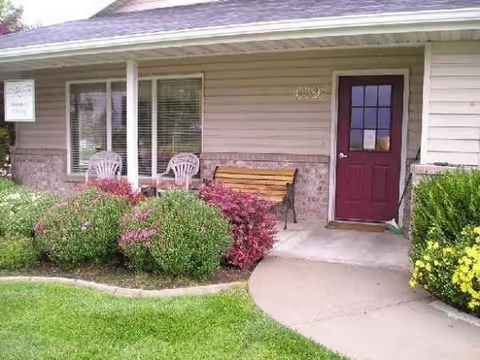
Facility condition and infection-control items are mixed. Some reviewers appreciate the home-like, cozy environment and respect for personal space; others raise sanitation concerns, maintenance shortfalls, and pest-control concerns in certain areas. These are operational issues that affect resident comfort and should be assessed directly during a facility visit.
Management and compliance present two narratives. Recent leadership receives specific praise for hands-on improvements, better communication, and a more positive culture. At the same time, earlier management is criticized for poor responsiveness, disputes over refunds or contracts, and serious claims including alleged financial impropriety and restricted residency-placement practices. There are also mentions of noncompliance with smoking/clean-air policies. These patterns indicate both improvement under new management and unresolved regulatory or administrative concerns that prospective families should verify.
For prospective residents and families: visit the facility more than once, meet current nursing leadership, ask for staffing ratios and turnover data, review dining menus and dietitian access, inquire about activity schedules, and request documentation of pest-control and sanitation protocols. If contract or financial issues are a concern, obtain written policies on refunds, billing, and resident-placement practices. Observing the current operations in person will give a clearer sense of whether the recent improvements noted by reviewers are consistent facility-wide.