Reviewer commentary on Fonthill Care Gardens Inc. is mixed, with clear positive features alongside several operational concerns that prospective residents and families should evaluate during a visit.
Care quality: Several comments describe capable dementia management and staff who can work with combative Alzheimer’s patients, supported by references to a strong clinical presence (doctors and nurses). At the same time, there are statements indicating inconsistent care quality and responsiveness, and at least one critique raises substantive concerns about dining and basic care standards. These contrasting notes suggest variability in care experience; families should ask about staffing levels, clinical oversight, and incident/concern escalation protocols when assessing fit.
Staff and culture: Many reviewers praise friendly, courteous staff and specific employees who build rapport with residents. The facility appears to foster a homely, peaceful atmosphere consistent with a smaller-scale setting. However, language coverage is uneven: activity selections and staff-language availability have limitations (e.g., Spanish-language programming and limited Farsi-speaking coverage at night). Prospective residents who require specific language support should verify multilingual staffing and after-hours communication plans.
Dining and sanitation: Comments include both positive and negative impressions. While some reviewers characterize the facility as consistently clean, other remarks indicate concerns about food quality and food-safety practices. Given the potential for significant impact on resident well-being, families should review menus, food-preparation procedures, and recent health inspections, and ask how dietary needs and complaints are handled.
Activities and engagement: The facility offers scheduled activities, and reviewers noted accessibility to some programming. Conversely, several descriptions indicate low-engagement options dominated by television and limited physical-activity accessibility for residents with mobility needs. This points to a need to clarify the activity calendar, staffing for one-on-one engagement, and adaptive or accessible offerings for residents with limited mobility.
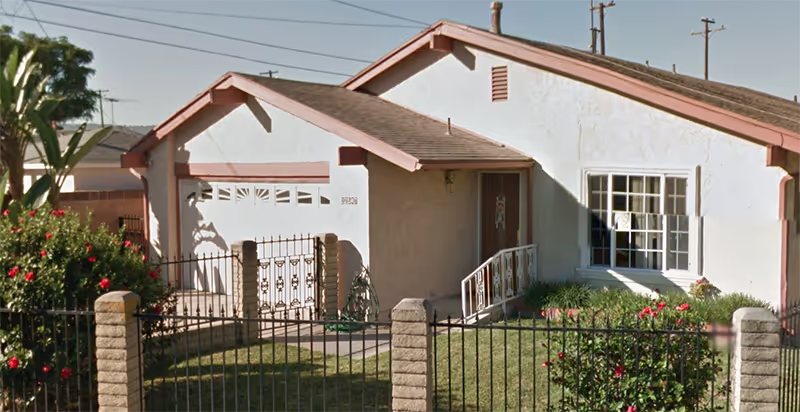
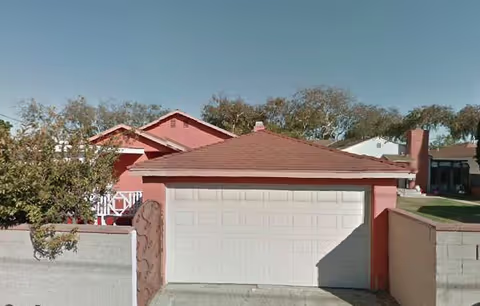
Facilities and accessibility: Physical accommodations were generally described positively in terms of attractive rooms and layout, and the site is noted as conveniently located near Prairie/Roscranns. Nevertheless, at least one reviewer identified limitations for participating in physical activities, suggesting that mobility aids, accessible exercise options, or tailored rehabilitation services may be limited or need verification.
Management and transparency: One recurring theme is a mismatch between tour impressions and the on-site reality for some families, indicating potential issues with marketing transparency or inconsistent information during admissions tours. Additionally, variability in care and dining experiences implies management oversight and quality-control practices should be discussed directly with leadership.
Notable patterns and guidance: The resident population appears to be skewed toward male residents with significant cognitive impairment; this may influence daily rhythms, programming, and peer interactions. There are also mixed signals on cleanliness versus food-safety and care consistency. To assess suitability, families should request a detailed tour during active hours, review staffing ratios and language coverage (including night coverage), inspect dining operations, ask for references from current families, and clarify how the facility manages dementia-related behaviors and individualized activity plans.