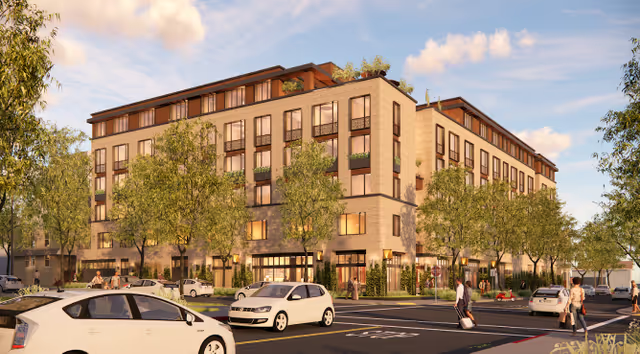
Overall impression: St. Paul's Towers presents as an upscale, single-building continuing care retirement community with many hotel-like amenities, prominent views, and a strong emphasis on social programming. The campus offers a broad range of housing types and an advertised continuum of care, along with extensive amenity spaces such as libraries, gyms, rooftop and street-level gardens, multiple dining venues, and on-site salon and workshop spaces. Its central, walkable location near Lake Merritt and retail destinations is a recurring advantage for prospective residents.
Care and clinical services: The facility includes short-term rehabilitation and long-term skilled nursing options and is frequently commended for attentive, compassionate nursing and therapy staff. Rehabilitation services and patient-focused therapy are noted strengths. However, there are recurring concerns that clinical-care quality can be variable across long-term care units. These concerns relate to wound-care management and responsiveness to clinical needs in some units, and reviewers also note the absence of an on-site geriatric psychiatrist or equivalent mental-health specialty coverage. Admission practices and the availability of higher-level care placements can appear inconsistent; prospective residents should confirm how transitions between independent, assisted, memory, and skilled levels are handled for their specific situation.
Staff and management: Staff across departments are commonly described as professional, welcoming, and helpful; families report good communication in many interactions, and management is often characterized as organized with efficient security and operational systems. At the same time, accounts indicate variability in day-to-day staff responsiveness and resident engagement in certain areas or shifts. Management is praised for program offerings and logistics (transportation, appointments, concierge services), but reviewers also highlight unevenness in operational consistency that merits direct inquiry during a tour.
Dining and nutrition: Dining is a clear positive in many accounts — freshly prepared, cooked-from-scratch entrees, buffet options, texture-modified meals, snack carts, and family-meal options are regularly mentioned. The dining rooms and bistro-style outlets are described as attractive and social focal points. A minority of comments indicate average or inconsistent meal experiences in specific units; overall, dining quality is a strength but prospective residents should sample meals and discuss menu-cycle consistency and special-diet accommodations.
Activities and social life: The community emphasizes active resident life, with abundant programming (exercise classes, lectures, arts, weekly movies, outings to cultural events) and noted high levels of resident participation. Transportation services that support off-campus activities are robust. This environment supports social engagement and new friendships for many residents.
Facilities and living units: Apartments range from studios to two-bedrooms with thoughtful floor plans, walk-in closets, storage, and floor-to-ceiling windows in many units. Common areas are generally well maintained and attractive, with wood finishes and hotel-like design. Some parts of the building are older and have smaller common spaces; glare from large glass surfaces is noted in places. Prospective residents should verify specific unit sizes, whether furniture must be provided, and compare floor plans versus price.
Notable patterns and practical considerations: Cost and pricing transparency are recurring practical concerns — the community is frequently characterized as expensive and pricing can vary by unit and level of care. Prospective residents should obtain up-to-date, written pricing and ask about what services and fee increases are included. The location is a strong asset, but immediate retail options are limited in places. Infection-control protocols (PPE checks, vaccination verification, occupancy limits during COVID) have been emphasized as actively enforced; families should review current visitation and outbreak policies. Finally, while many reviewers praise the community and staff, the existence of substantive clinical concerns in some long-term care units suggests that prospective residents and families perform targeted due diligence: review clinical staffing ratios, ask about specialty mental-health coverage, tour skilled-nursing areas, and request recent quality and inspection information before making a placement decision.