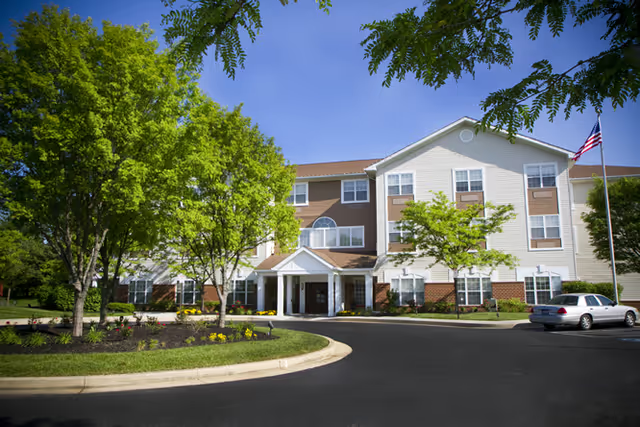
Autumn Lake Healthcare at Overlea elicits strongly divergent impressions from families and former residents. Many accounts describe an effective, recovery-focused rehabilitation program with skilled therapists who produce measurable gains in mobility and function, and numerous individual staff members across admissions, social work, nursing, and therapy are singled out for compassionate, attentive care. Those positive experiences emphasize clear medication counseling, good pain management, thoughtful discharge planning, and an active activities calendar that includes games and birthday events contributing to residents’ engagement.
At the same time, a substantial set of reviews identifies operational weaknesses that affect basic care and the resident environment. Clinical concerns include inconsistent monitoring (for example, medication administration, vital-sign oversight, and wound-care practices), uneven attention to repositioning and pressure-area management, and gaps in fall-risk mitigation. Multiple accounts point to delays in responding to call lights and care requests, and reviewers describe variability in aide and nursing availability across shifts, with evenings and weekends most frequently noted as problematic.
Facility and environmental issues are another recurrent theme. Reviewers describe older infrastructure and maintenance shortfalls such as air-handling/HVAC problems, elevator and flooring faults, and pest-control concerns. Sanitation and odor issues in rooms and common areas, inconsistent laundry/linen availability, and room overcrowding or shared-room configurations are cited as affecting comfort and privacy. These conditions are sometimes presented alongside privacy concerns such as doors left open or unit-assignment practices that may not align with a resident’s clinical needs.
Dining and activities yield mixed feedback. The activities program and therapy scheduling receive consistent positive comments for keeping residents engaged and accelerating functional recovery. Dining receives more variable marks: some reviewers praise meals and attentive dining staff, while others describe limited menu variety, small portions, or cold and processed-feeling meals. Family members advising prospective residents commonly recommend observing mealtimes as part of an evaluation.
Management and communication are described as uneven. Positive notes highlight helpful admissions staff and individual managers who follow up on concerns, but numerous reviews describe poor communication channels, misrouted phone calls, difficulty locating residents, delayed notifications about clinical events, and inconsistent complaint resolution. There are also mentions of billing or administrative follow-up issues and at least one reference to alleged financial or marketing misconduct, which families may want to investigate directly with the facility and regulators.
Taken together, the pattern across reviews is one of high variability: the facility demonstrably provides strong rehabilitative care and has many dedicated, effective staff members, yet operational and environmental inconsistencies create risk and dissatisfaction for some residents and families. Prospective residents and their families should consider on-site observations across different shifts, ask specific questions about staffing ratios, wound-care and pressure-area protocols, emergency-transfer procedures, laundry and linen schedules, infection-control practices, and billing policies. Asking for names and credentials of key clinical contacts, checking recent inspection reports, and arranging visits during mealtimes and evening shifts will help assess whether the facility’s strengths align with the needs of a particular resident.