The reviews for Prestige Care Center of Plattsmouth present a mixed picture. Many families and visitors praise the facility for compassionate, attentive caregiving, a homelike atmosphere, and an active, engaged community. At the same time, several substantive operational concerns are described that would merit direct inquiry by prospective residents and their families.
Care quality and clinical operations: Positive comments emphasize devoted nursing staff who provide hands-on assistance, emotional support, and effective family communication. Conversely, other accounts point to inconsistencies in clinical assessment and documentation, including examples of missed or delayed recognition of changes in condition and problems with transfer safety. Medication and pharmacy coordination were identified as problematic in some narratives, and family members described confusion about rehabilitation length and discharge authorization. These contrasting accounts suggest that while many residents receive attentive care, there are lapses in clinical reliability that could affect higher-acuity patients.
Staff, training, and culture: A recurring theme is a core of dedicated caregivers and leadership that fosters a warm, family-like environment. Staff morale and teamwork were noted positively in multiple comments. However, reviewers also described variability in staff professionalism and communication tone, along with stated gaps in training for some clinical tasks. The net impression is of a facility with strong individual caregivers and leadership strengths, but with uneven consistency across shifts and job roles.
Management, administration, and billing: Administrative assistance with paperwork and responsiveness to family questions were highlighted as strengths. At the same time, there are reports of confusing billing practices and unclear processes around rehab timelines and return-admission decisions; one item referenced an allegation of billing manipulation. Physician coverage patterns were also questioned—families noted limited on-site physician or advanced-practice presence and reliance on weekly physician rounds—which could affect timely medical oversight.
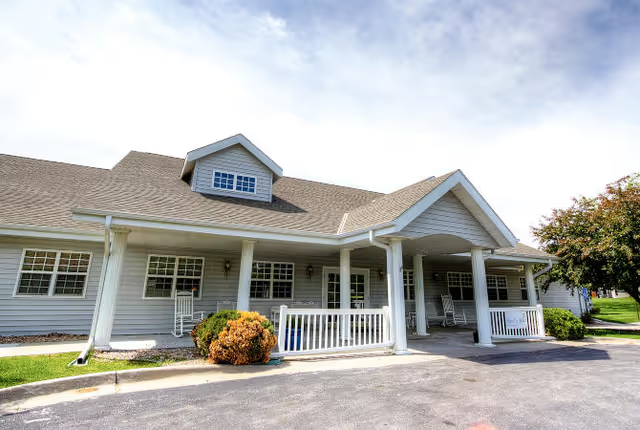
Activities, facilities, and cleanliness: The facility receives praise for engaging activities, services that accommodate resident needs, and a generally home-like environment. Several reviewers described the site as clean and well-maintained; others reported cleanliness inconsistencies or sanitation concerns in specific areas. Dining received little direct commentary in these summaries, so additional inquiry during a visit is advisable to assess food quality and meal-service continuity.
Notable patterns and suggestions for families: The dominant positive pattern is strong, compassionate direct care and an inclusive community culture. The dominant concerns are operational: inconsistent clinical processes, transfer safety and training gaps, coordination with pharmacy and physicians, delays responding to resident call systems, and unclear billing/discharge procedures. Prospective families should visit in person, observe multiple shifts if possible, ask about transfer-training protocols, nurse-to-resident ratios, on-site physician/PA coverage, call-response metrics, pharmacy processes, and typical rehabilitation timelines and billing procedures. Reviewing recent inspection reports and asking for references from current resident families can help clarify whether the strengths or the operational concerns are more representative of typical resident experience.